

 无障碍阅读
无障碍阅读
 6645
13290 Maximum Capacity
6645
13290 Maximum Capacity


The construction of Lingqu directly responded to Emperor Qin Shi Huang's military needs for conquering the Baiyue tribes, and was a key project to consolidate the central dynasty's rule over Lingnan.
Solving the Southern Expedition Dilemma: At the end of the Warring States period, the 'Baiyue' tribes living in the Lingnan region (present-day Guangdong Province, Guangxi Zhuang Autonomous Region, and northern Vietnam) had not yet submitted. When the Qin army attempted to conquer the south, the Nanling Mountains posed an obstacle, and all grain transportation relied on land routes. The treacherous mountain paths and low transportation capacity led to the situation where 'they did not remove their armor or put down their bows for three years,' and military progress was extremely slow.
Opening Strategic Passages: After Lingqu was opened in 214 BC, the Qin army could enter Lingqu through the Xiang River, a tributary of the Yangtze River, and then transfer to the Li River, a tributary of the Pearl River, achieving the goal of 'the Xiang and Li rivers diverge and support each other, making navigation possible.' Through waterway transportation, grain and supplies could quickly move south, allowing the Qin army to rapidly reverse the war situation, finally pacifying the Baiyue and officially incorporating the Lingnan region into the central dynasty's territory, achieving the first political unification between the Central Plains and Lingnan.
Long-term Military Guarantee: Subsequently, Lingqu became a military passage for successive dynasties to control Lingnan. Whenever rebellions occurred in the south or frontier defense needs arose, the central army could quickly deploy troops and supplies through Lingqu, thereby strengthening the central government's military deterrence over the south and consolidating the unity of the multi-ethnic state.
Lingqu is the world's first artificial canal to connect the Yangtze River basin and the Pearl River basin, and its engineering wisdom and historical value are unique.
Milestone of River System Connection: The Yangtze River and Pearl River are two major independent river systems in southern China. Lingqu ingeniously designed (diverting the Xiang River to flow into the Li River) to connect the two major basins for the first time. This opened the 'last kilometer' of north-south water transportation in China, changing the water transportation between the Central Plains and Lingnan from a 'disconnected state' to a 'directly connected state.'
Model of Water Conservancy Engineering: Lingqu has a total length of 37 kilometers, and its core technology 'Doumen' (equivalent to modern locks) is the world's oldest lock system. It solved the navigation problem caused by the water level difference between the Xiang and Li rivers (about 6 meters) by gradually raising the water level, a technology that preceded the earliest locks in Europe by over 1000 years. This design of 'using gates to save water and using water to navigate ships' demonstrates the ancient craftsmen's accurate understanding of hydrology and mechanics, becoming a model for later water conservancy projects.
Historical Continuity: From the Qin Dynasty until the rise of modern railways and highways, Lingqu served as the main north-south water transportation route for over 2000 years. As one of the longest-used artificial canals in Chinese history, its stability and practicality far exceeded other water conservancy projects in the world at that time.
Lingqu has received high praise from Chinese and foreign academic circles for its outstanding engineering technology and historical value.
Together with Dujiangyan and Zhengguo Canal, it is called the 'Three Great Water Conservancy Projects of the Qin Dynasty,' but its unique 'cross-basin navigation' function occupies an independent position among ancient water conservancy projects.
The international hydraulic engineering community calls it the 'Pearl of Ancient Water Conservancy Architecture in the World,' and its 'Doumen' design is recognized as the 'Father of Locks,' providing important technical reference for later canal projects (such as the Beijing-Hangzhou Grand Canal).
In 2018, Lingqu was selected as a 'World Heritage Irrigation Structure,' becoming an important symbol of Chinese ancient water conservancy achievements being widely known to the world.
The influence of Lingqu far exceeded military and transportation, more profoundly shaping the development pattern of southern China.
Economic Development: After navigation was opened, iron tools, silk, and handicraft technologies from the Central Plains were transmitted to Lingnan through Lingqu, while products from Lingnan such as rice, spices, and pearls were transported north to supply the Central Plains. This contributed to the transformation of the Lingnan region from 'barren land' to 'land of fish and rice,' accelerating the development of southern agriculture and handicrafts.
Cultural Integration: Central Plains culture (writing, etiquette, imperial examination system, etc.) moved south through Lingqu, colliding and integrating with the Baiyue culture of Lingnan to form unique Lingnan culture (Cantonese, Lingnan architecture, etc.). This strengthened the cultural identification of southern residents with the central dynasty and laid a cultural foundation for forming the cohesion of the multi-ethnic state.
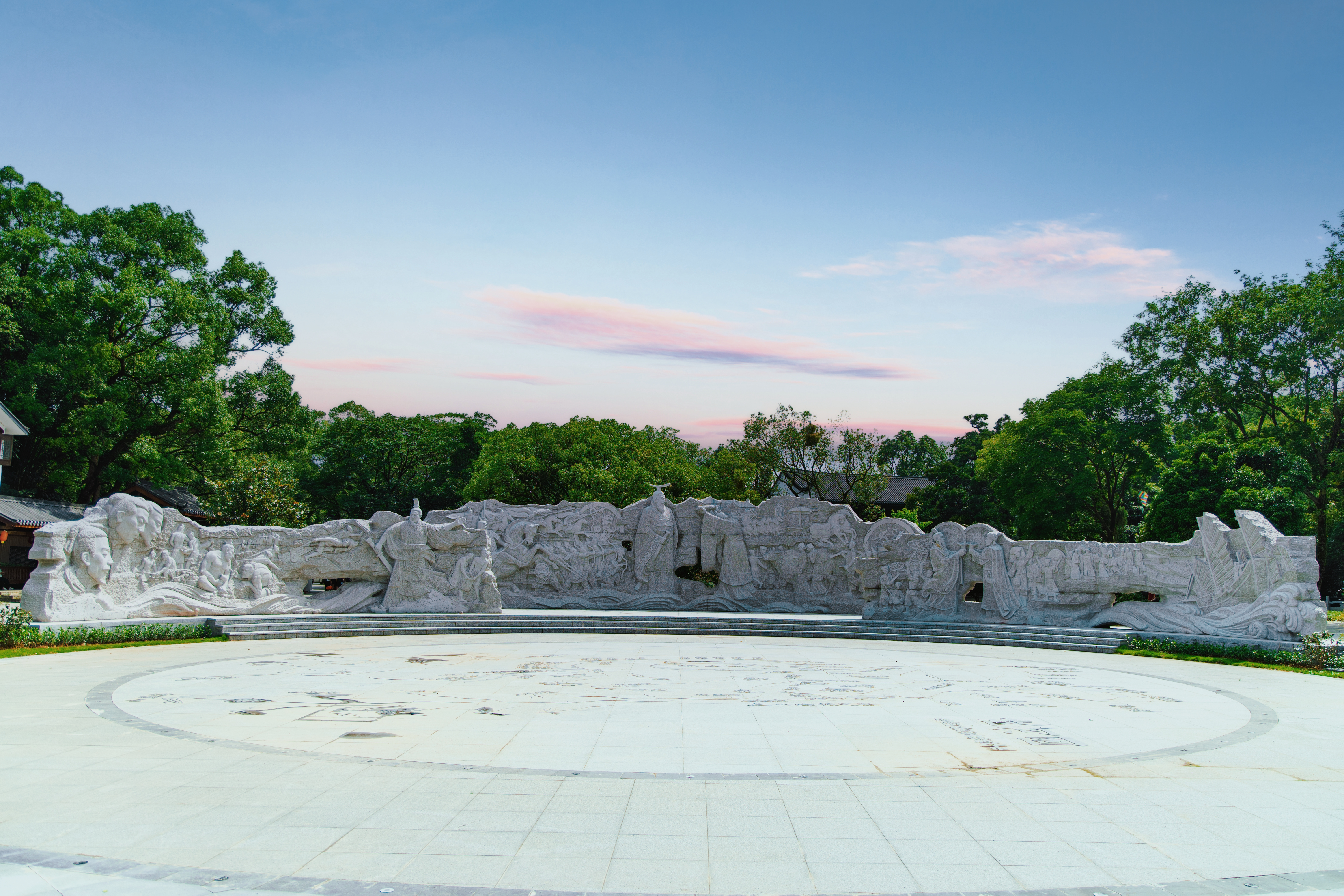


Lingqu Lansheng displays its historical value in three chapters based on the water of Lingqu. The relief in the central section of the back row is Chapter 1, themed by unifying Lingnan and strengthening the border, showing the background of the first emperor of the Qin Dynasty who expanded territory, as well as the scene of assigning Shi Lu to build Lingqu. The relief on the left side of the front row is Chapter 2, and focuses on water conservancy and transport, telling the heroic deeds of Shi Lu leading the three generals and soldiers to dig Lingqu. The relief on the right side of the front row is Chapter 3, and connects the scenes, such as ethnic unity, transit of Annam envoys, and gathering of merchants, which describes the significant contributions made by Lingqu to the development of the Maritime Silk Road.
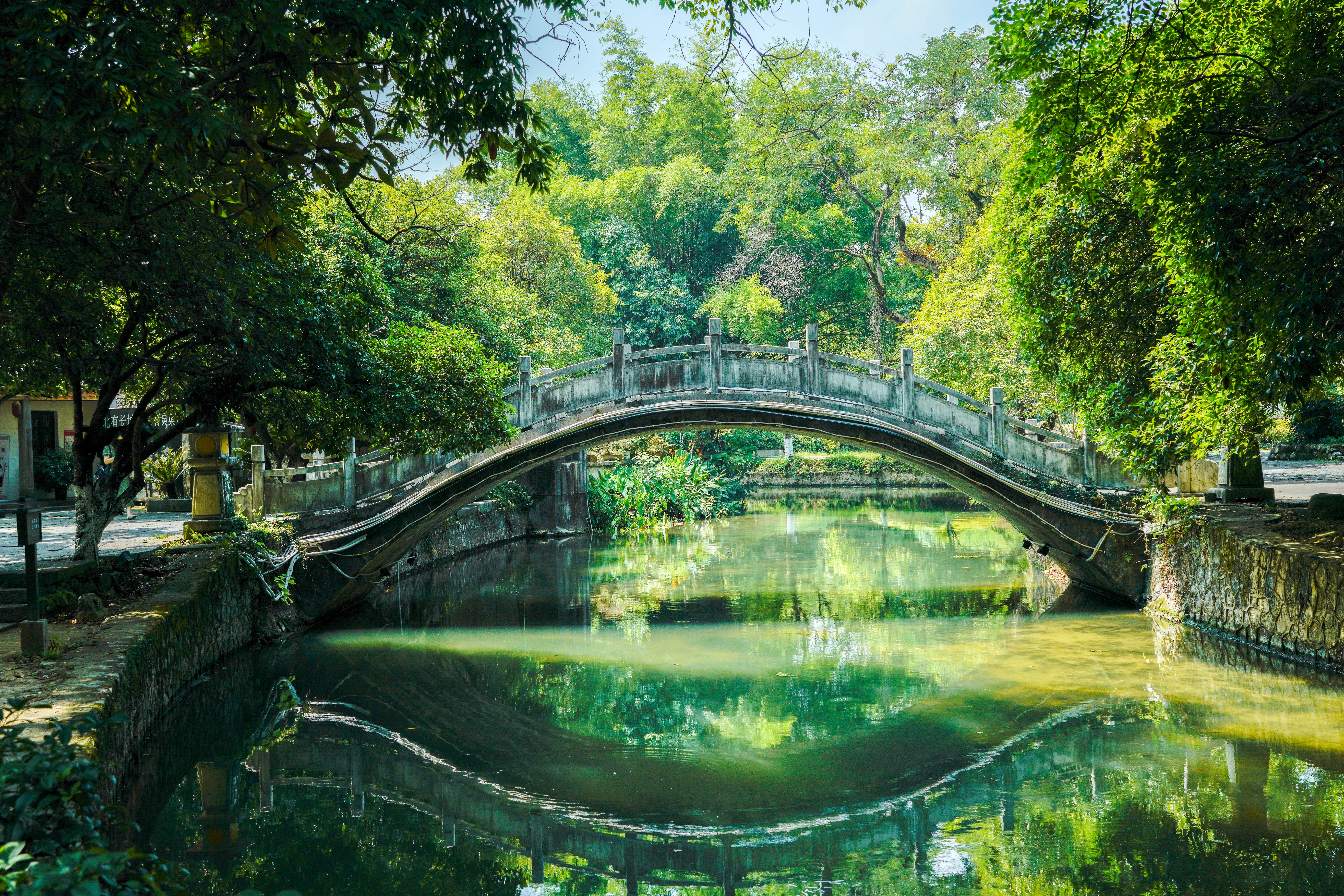
Meiling Bridge is a white marble arch bridge with exquisite appearance. In August 1941, Chiang Kai-shek and his wife Soong May-ling visited Lingqu. When passing through the South Canal, Soong May-ling found that the bridge with bamboo and wood structure was unsafe and proposed to build a stone arch bridge here. After the bridge was completed, people named it "Meiling Bridge" to express gratitude for Soong May-ling's concern for Lingqu.
Sixian Ancestral Temple, also known as Lingji Temple, was built in the 15th year of Zhizheng in the Yuan Dynasty (1355). It enshrines four sages who made contributions to the excavation and management of Lingqu: Shi Lu, the investigating censor of the Qin Dynasty; General Fubo Ma Yuan of the Han Dynasty; Li Bo, the Guiguan observation officer of the Tang Dynasty; and Yu Mengwei, the defense censor. Hence it is named "Sixian Temple." This temple was built together when Yeerjini, the vice director of Guangxi Department of Supervision & Clean Governance, repaired Lingqu. The tablet "Records of Lingji Temple" written by Huang Chang of the Yuan Dynasty is still preserved today. It has been renovated many times throughout the dynasties, and the current Sixian Ancestral Temple was rebuilt in 1985.
This tree is a Bischofia polycarpa, over 780 years old. The trunk is covered with knots, but the leaves are lush and full of vitality. Strangely, the tree has swallowed one-third of the inscription tablet "New Statues of Black God and Mercury" from the 12th year of Emperor Qianlong's reign (1747), causing the tablet to be parallel to the ground and suspended about 30 centimeters above the ground. Currently, one-third of this tablet has been absorbed into the trunk, with the remaining two-thirds exposed outside the tree. Moreover, this tree continues to "swallow" the tablet at a rate of 1 centimeter every three years. It is predicted that the entire tablet will be completely enveloped by the ancient tree in about 200 years.